A pool can look clear while one number drifts toward trouble. Testing only after the water turns green costs chemicals and filter time. Build a repeatable routine: take a clean sample, read the core parameters, record them, then adjust one supported problem.
Quick answer
Test free chlorine and pH first, then total alkalinity and cyanuric acid before making a large correction. Take water away from returns and chemical feeders, follow the kit’s exact timing, compare colors in neutral daylight, and write the result down. Testing is a set of connected readings—not one strip square—and every adjustment needs circulation plus a later retest.
What pool water testing actually does
A test does not “balance” water. It gives you a snapshot that helps answer three questions:
- Is enough active sanitizer present?
- Is the water balanced so sanitizer and equipment can work as intended?
- Which single adjustment should come next, if any?
Your baseline includes free chlorine (FC), pH, total alkalinity (TA), and cyanuric acid (CYA). Calcium hardness matters for scaling and surfaces. Salt matters in a salt chlorine generator. Combined chlorine and metals answer narrower questions when a symptom supports checking them.
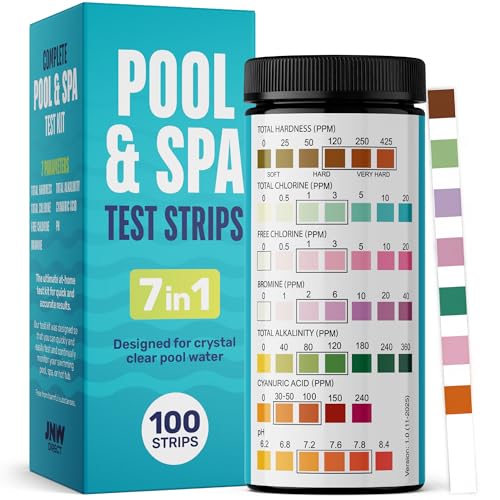
A multi-parameter test strip makes routine trend checks fast. Keep a second fresh strip pack sealed until the first bottle expires or gets wet. Neither replaces reading the bottle, checking expiration, or confirming an unclear color before a large dose.
What this is not
Testing is not learning one “perfect chlorine number” and ignoring everything else. FC, pH, TA, and CYA work together. FC can disappear when CYA is too low. High CYA can make a familiar chlorine target inadequate. Unstable TA can move pH even while you add pH products.
Testing also is not a contest between strips and liquid kits. Strips are quick for trends. Liquid kits can confirm results when water is green, cloudy, or expensive treatment depends on the number. A store test offers a second opinion, but keep your own history.
Do not treat clear water as proof every reading is fine. Test on a schedule, then use symptoms as a reason to test again—not as the test.
What each number tells you
Free chlorine: what is ready to sanitize
Free chlorine is the available sanitizer residual. It rises after dosing and falls as sunlight, swimmers, leaves, and algae consume it. A low result can mean the pool needs chlorine, or point to low CYA, active algae, heavy use, or an underperforming salt cell.
Do not add tablets automatically when FC is low. Tablets may add CYA. Choose a target with the sanitizer label and CYA in mind. The familiar 1–3 ppm range appears in common residential guidance and product labels, but treatment and salt-system targets differ.
pH: how acidic or basic the water is
pH affects sanitizer behavior, comfort, scaling, and corrosion. Many residential pools are managed around 7.2–7.8, though surfaces, equipment, and labels set the boundaries.
Do not chase a tiny color difference. Confirm a result near the edge before adding acid or soda ash. Aeration, salt cells, TA, fresh plaster, rain, and chemical additions can move pH.
Total alkalinity: the pH buffer
TA slows sudden pH movement. Too little buffer can make pH swing; too much can help pH climb and increase scaling pressure. A commonly cited working range is about 80–120 ppm, but sanitizer type and pool surface can shift the preferred target.
TA is not pH. One measures buffering capacity; the other measures the current acid-base condition. You can have a normal pH with unsuitable TA, which is why testing one without the other misses the cause.
Cyanuric acid: chlorine’s sun shield
CYA protects chlorine from rapid sunlight loss. Too little can make FC vanish on a sunny day. Too much means you may need more FC for the same sanitation effect and can make recovery from algae harder. Stabilized chlorine products can raise CYA over time.
CYA changes slowly unless water is diluted or stabilizer is added. Test it after filling, major rain and drain events, sustained tablet or dichlor use, and whenever chlorine will not hold as expected.
Calcium hardness, salt, and other checks
Calcium hardness matters for plaster protection and scale risk. Salt concentration matters to the chlorine generator’s operating range. Metals matter when water is clear but tinted or stains appear. Combined chlorine helps explain a strong chloramine issue when the test method supports it.
Do not test every specialty parameter every day. Use the core four routinely, then add a test because a system, season, product, or symptom calls for it.
Typical ranges are a starting point
These are common residential reference bands, not permission to ignore your equipment and product labels:
| Parameter | Common starting range | Why it matters |
|---|---|---|
| Free chlorine | Often 1–3 ppm for routine residential use | Sanitizer residual; must be interpreted with CYA and product guidance |
| pH | About 7.2–7.8 | Sanitizer behavior, comfort, corrosion, and scale |
| Total alkalinity | Often 80–120 ppm | Buffers pH movement |
| CYA | Often about 30–50 ppm in manually chlorinated outdoor pools | Protects chlorine from sunlight; system targets vary |
| Calcium hardness | Surface- and system-dependent | Low and high values create different surface and scale risks |
| Salt | Generator-specific | Must match the cell maker’s operating band |
If your label, pool-surface documentation, or salt-cell manual specifies another range, use that source. The chemical dose calculator can estimate a correction only after you have reliable current and target values.
Decision tree: which test method fits today?
Use strips for a fast routine check
Choose strips when the water is clear, you are tracking a familiar pool, and you need a quick trend across several parameters. Keep the bottle closed and dry. Seven-in-one strips fit this role; a fresh comparison strip can help expose a bottle damaged by humidity.
Skip strips when color vision, poor lighting, faded pads, or wide scale intervals make the decision unclear. Do not use them after storage in a hot vehicle, with wet fingers inside the bottle, or past expiration.
Use a liquid kit for confirmation and troubleshooting
Choose a liquid kit when FC must be measured more closely, CYA is driving a treatment decision, algae is active, or repeated strip readings conflict with the pool’s behavior. Follow drop size, swirling, sample volume, and endpoint directions exactly.
Skip a kit with expired or discolored reagents. Do not substitute drops between kits unless the manufacturer explicitly says they are interchangeable.
Use a pool-store test as a second opinion
A store test can help confirm metals, hardness, salt, or a surprising home result. Bring a fresh sample in a clean container and ask for the printed readings before discussing products.
Skip immediate chemical purchases when the recommendation changes several parameters at once. Do not accept a dose until the pool volume, product strength, and current reading are correct.
Saltwater, chlorine, above-ground, or inground
Saltwater pools need FC, pH, TA, and CYA checks plus salt and cell condition. Above-ground pools demand accurate volume because smaller amounts amplify dosing errors. Inground pools can have circulation gaps, but routine samples still need well-mixed water.
What you’ll need
- A fresh strip bottle or liquid test kit that covers the needed parameters
- A clean plastic sample cup used only for pool water
- Neutral daylight or a white background for color comparison
- A timer for exact dip, swirl, and read windows
- A log in a notebook, spreadsheet, or phone
- Pool volume and product-label information
- Dry storage locked away from kids and pets
Our pick for a quick weekly trend is a sealed bottle of multi-parameter strips. It suits a clear pool with stable history. Skip it as the only evidence before a major algae dose or when two color blocks look nearly identical.
For buying criteria rather than chemistry instructions, browse Pool Essentials. Focus on readable scales, parameters you actually use, reagent replacement availability, storage needs, and the test’s stated range.
Step-by-step: test, read, compare, record, adjust
1. Test a representative sample
Run the pump long enough to mix the water. Take the sample about elbow-deep, away from returns, skimmers, steps, feeders, and recent chemical additions.
For strips, avoid touching the pads, close the bottle, dip as directed, and start the timer. For a liquid kit, rinse the cell with pool water, fill to the line, and hold bottles as instructed.
A fresh test strip is useful only when sampling and timing are consistent. If your bottle has been left open, compare once with a new sealed bottle before changing chemistry. Changing the method every week hides trends.
2. Read inside the stated window
Match strip colors at the exact time printed on the package. Some pads continue changing after the valid window. Read in neutral daylight rather than under colored patio lights or deep shade.
With a liquid kit, count drops, swirl as directed, and stop at the stated endpoint. If a result exceeds the kit’s range, use the maker’s approved dilution method or another test.
3. Compare connected parameters
Read FC beside CYA, and read pH beside TA. Then compare the current result with the previous log, recent weather, swimmer load, and chemical additions.
- FC low + CYA low may point to sunlight loss.
- FC low + normal CYA + cloudy green water may point to active sanitizer demand.
- pH rising repeatedly + high TA may point to excess buffering and aeration effects.
- FC normal + clear green tint may point away from algae and toward metals.
Do not correct every out-of-range square at once. Decide which relationship explains the current risk and which order your product labels require.
4. Record the reading and conditions
Write the date, time, FC, pH, TA, CYA, water temperature if available, filter pressure, weather, pool use, and anything added since the last test. A simple history catches patterns that a single result cannot.
If a salt cell is involved, note output and pump runtime. Record major rain or replacement water. Mark an uncertain strip color as uncertain rather than inventing precision.
5. Adjust one supported problem
Use the product label, current reading, target, pool volume, and product concentration. Make a partial correction when the label supports it, circulate for the stated time, and retest before the next dose.
The pool dose calculator can help check arithmetic, not diagnose the cause. If its result page suggests a testing kit, treat that as a reminder to verify your inputs—not proof that you need a purchase.
When strips are expired or cannot separate the target range, replace them with fresh multi-parameter strips. Do not buy more balancer to compensate for an unreliable test.
If a reading is low: how to raise it
Free chlorine is low
First ask why. Check CYA, clarity, recent use, sunlight, pump runtime, cell operation, and debris. Add a compatible sanitizer by its label. If water is green, use the green pool repair sequence rather than treating one number alone.
Skip stabilized chlorine when CYA is already too high. Do not send shock through a skimmer connected to a tablet feeder.
pH is low
Confirm the result and review TA. Use a labeled pH increaser, commonly sodium carbonate, in a measured amount. Add gradually and circulate. Large corrections can overshoot and cloud the water.
Skip blind pH raising when TA is also very low or a recent acid dose has not mixed. Do not mix pH increaser with chlorine in a bucket.
Total alkalinity is low
Use a labeled alkalinity increaser, often sodium bicarbonate, based on volume and the desired ppm change. Raise in stages, circulate, and retest pH as TA changes.
Skip the full calculated correction in one dump when the pool is small or volume is uncertain. Do not assume household and pool products have identical purity or directions without checking the label.
CYA is low
Use stabilizer only after confirming the reading and accounting for stabilized chlorine already in use. CYA can take time to register by the method specified on the product, so redosing too soon can overshoot.
Skip stabilizer for indoor pools unless the operating plan calls for it. Do not add more because a test taken too soon still reads low.
If a reading is high: how to lower it
Free chlorine is high
Stop adding chlorine, remove or turn down the source when safe, keep circulation running, and allow normal loss according to the product guidance. Keep swimmers out until the reading falls within the label’s allowed range.
Do not add a neutralizer casually; overshooting can leave the pool with no sanitizer. Do not rely on smell as a chlorine measurement.
pH is high
Confirm pH, review TA, and use a labeled pH reducer such as muriatic acid or sodium bisulfate. Measure carefully, add as directed, circulate, and retest. Acid strength varies.
Skip acid addition when the test is above its readable range until you confirm the value. Never combine acid and chlorine; the reaction can release toxic gas.
Total alkalinity is high
Lowering TA usually uses acid to reduce both TA and pH, followed by controlled aeration to raise pH without restoring the removed alkalinity. Repeat in measured cycles rather than forcing one large correction.
Skip this process if you cannot monitor pH closely. Do not pour acid in one concentrated spot unless the label and pool-surface instructions explicitly direct it.
CYA is high
CYA generally comes down through partial drain-and-refill or water replacement rather than another balancing chemical. Check local discharge rules, groundwater conditions, liner risks, and the pool builder’s guidance before lowering water.
Skip draining a vinyl pool too far or emptying any pool without understanding structural risk. Do not add more tablets or dichlor while trying to reduce CYA.
How one parameter fights with another
TA versus pH
TA resists pH movement. High TA can help pH rise, especially with aeration or a salt cell. Low TA can permit swings after rain or dosing. Repeatedly fixing pH without TA misses the pattern.
FC versus CYA
CYA protects chlorine from sunlight but changes how much FC is needed. Low CYA can make FC disappear. High CYA can make a familiar FC target inadequate. Read the pair together.
pH versus sanitizer and scale
High pH can reduce chlorine effectiveness and raise scale pressure. Low pH raises corrosion and surface concerns. pH changes can also alter metal tint or stains, so clear green water deserves caution.
Calcium, TA, pH, and temperature
Scale risk is not a calcium-only story. Calcium hardness, pH, TA, temperature, and dissolved solids interact. If a salt cell scales repeatedly, checking only calcium misses the operating pattern.
Safety notes (read this)
- Store strips and reagents in original containers, cool and dry, locked away from kids and pets. Heat and moisture damage tests.
- Check expiration dates and reagent appearance. Replace leaking, crusted, discolored, or expired materials.
- Read strips and color reactions only inside the manufacturer’s time window. A late color is not a valid result.
- Never pour used test reagents back into the pool or bottles. Dispose of them as the kit directs.
- Do not mix test reagents with pool chemicals. Keep the testing area separate from open chlorine and acid containers.
- Wear eye protection when handling liquid reagents and pool chemicals. Rinse accidental splashes with clean water and follow the product safety instructions.
- Never mix acid and chlorine; the combination can release toxic gas. Never mix different dry chlorines.
Common mistakes
- Testing beside a return or feeder. The sample can be much stronger or weaker than the mixed pool.
- Reading cheap strips late. Pads keep changing after the valid window, and old strips can flatten color differences.
- Chasing pH without TA. Repeated pH correction fails when the buffer is driving the movement.
- Treating FC without CYA. Sun loss or over-stabilization can make the chlorine plan fail again.
- Adding several products before retesting. You cannot tell which change worked, and incompatible chemicals can create dangerous reactions.
What to buy only if needed
Do not replace a working method because another package promises more squares. Buy when yours is expired, cannot measure a needed parameter, or lacks resolution. If moisture entered the bottle, a sealed replacement costs less than correcting a false reading.
A fresh strip bottle fits quick routine checks. Choose a liquid kit when algae treatment, CYA, or close FC control calls for better confirmation. Use a salt-specific test only for a salt system, and a metal test only when tint, fill water, heater history, or staining makes metals plausible.
Read the Essentials hub for test-method selection. The goal is a method you can store correctly, repeat the same way, and understand—not the kit with the longest label.
Related
Use the Chemistry hub to place readings in the wider system. For green water, follow the green pool guide and green-to-clear checklist. The first-year routine schedules tests, the dose calculator estimates a correction, and Problems starts with symptoms.
Key takeaways
- Testing means reading FC, pH, TA, and CYA together, not chasing one square.
- Sample well-mixed water away from returns, skimmers, and recent chemical additions.
- Follow exact dip, drop, lighting, and read-time directions.
- Record results so weather, use, filtration, and dosing patterns become visible.
- Raise or lower one supported problem, circulate, and retest before another dose.
- TA affects pH behavior, and CYA changes how FC behaves.
- Store test chemicals locked away, replace expired materials, and never mix reagents with pool chemicals.