Quick answer
Weekly pool care comes down to five moves: test the water, adjust chemistry in the right order, brush and vacuum, check the filter, and top off the water level. Skip a week in summer and algae starts anchoring, pH drifts, and chlorine demand spikes. This routine takes 20–30 minutes if you stay on top of it. Let it slide and you’re looking at a 3-hour rescue mission.
What this is not
Weekly care is not the same as opening or closing your pool. Those are seasonal events with their own chemical sequences — see the pool opening and closing checklist for those. Weekly care is also not a one-time shock treatment. Shock is a periodic boost you use when combined chlorine climbs or after a pool party, not the backbone of your routine. And it’s not just skimming leaves off the surface. Real weekly maintenance means testing water chemistry, physically scrubbing surfaces, and checking that your filter is actually doing its job.
Your first 7 days: setting up the weekly rhythm
If this is your first pool or first season maintaining one yourself, spend the opening week getting baseline numbers. Test everything, make small corrections, and write down what you see. You’ll use these numbers to know what “normal” looks like for your water.
Day 1–2: Establish your baseline
Test free chlorine (FC), pH, total alkalinity (TA), and cyanuric acid (CYA). Write the numbers down — a notebook or phone note works fine. If you don’t know your CYA level, test it now. CYA determines your minimum chlorine target, and without it you’re just guessing. See our pool water testing guide for strip vs liquid kit accuracy and which method fits your routine.
Day 3–5: First chemistry correction
Adjust TA first, then pH, then chlorine. This order matters — adjusting pH before TA will just push TA around and you’ll chase numbers all week. Wait at least 30 minutes between TA and pH additions so the first chemical has time to circulate. Use the chemical dose calculator to get exact amounts based on your pool volume instead of eyeballing it.
Day 6–7: Physical cleaning + filter check
Brush the walls and floor, vacuum or run the robot, empty the skimmer baskets, and check the filter pressure gauge. Write down your “clean” baseline pressure — that number is what you’ll compare against every week to know when it’s time to backwash or clean the filter.
The weekly rhythm: your maintenance checklist
This is the core routine you’ll repeat every week from opening to closing. Five steps, same sequence, 20–30 minutes if you stay consistent. Each step builds on the last — testing tells you what to adjust, adjustments keep the water balanced, brushing removes what chemicals can’t reach, the filter check ensures circulation is working, and topping off maintains the right water level for skimming.
Step 1: Test the water before touching chemicals
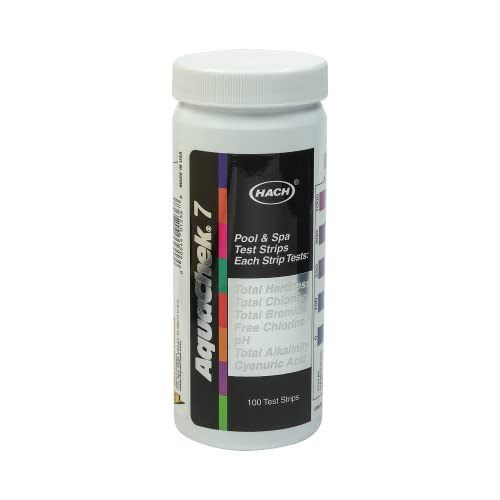
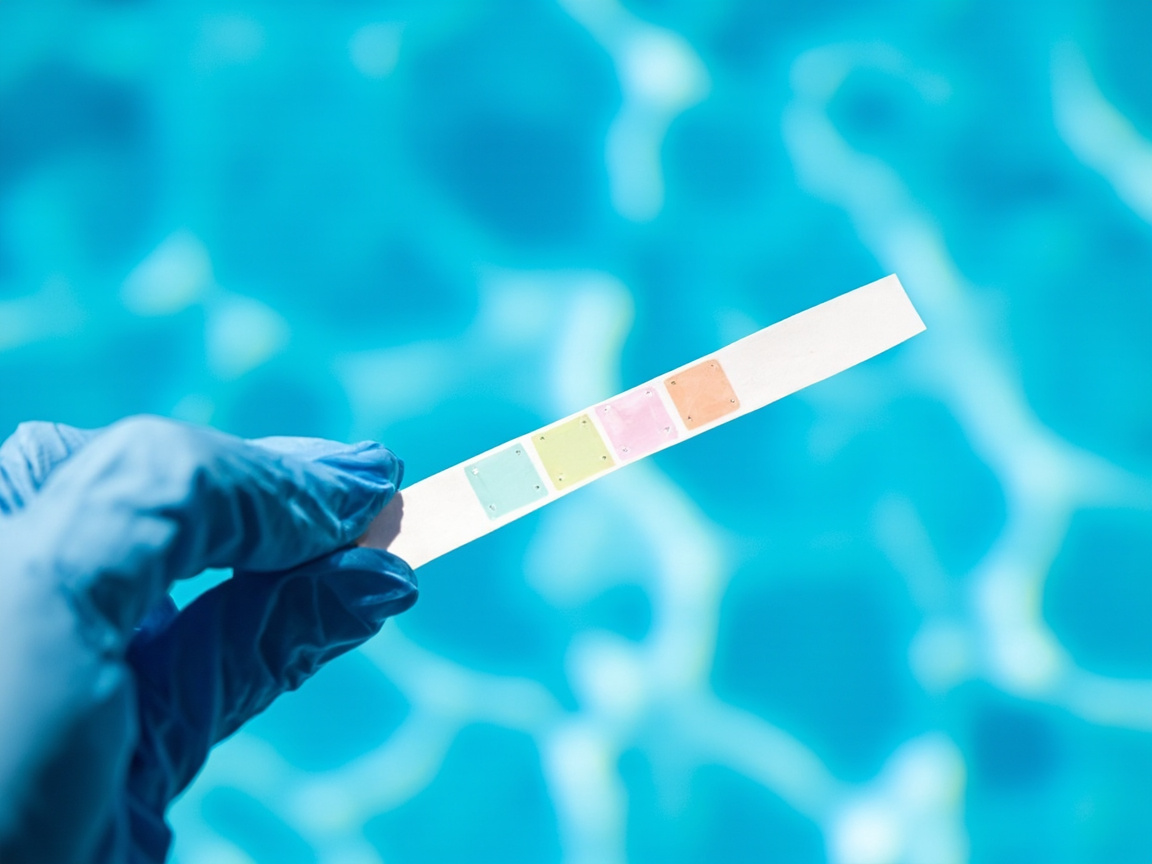
Test FC, pH, and TA every week. Check CYA monthly. The AquaChek 7-Way Test Strips give you all five readings plus hardness on one strip, which covers everything the weekly routine needs. Record every result — the trend matters more than any single test, and a log helps you spot drift before it becomes a problem. Salt pool owners should also check salt ppm and inspect the cell weekly. For a deeper dive into what each reading means, see understanding free chlorine and CYA interaction.
Step 2: Adjust chemistry in order — TA, then pH, then chlorine
Why this order: TA is the anchor for pH. Fix TA first and pH settles predictably. Add chlorine last so it’s not fighting pH swings.
- TA adjustment: If TA is below 80 ppm, raise it with baking soda (sodium bicarbonate). If above 120 ppm, lower with muriatic acid. See the total alkalinity guide for dosing details. A pH Down product works double duty here — it lowers both pH and TA.
- pH adjustment: After TA settles, check pH. Target 7.4–7.6. If pH is high, dose about 8 fl oz of muriatic acid per 10,000 gal to drop pH roughly 0.2 — always add acid to water, never the reverse. Use pH Down as a safer granular alternative. If pH is low, use pH Up (sodium carbonate) per the label dose. Confirm with a retest before adding chlorine. See the pH guide for ideal ranges by surface type.
- Chlorine: Check FC against your CYA-based minimum. Top off trichlor tabs in the floater or add liquid chlorine. Clorox XTRABLUE 3-inch tabs dissolve slowly and hold a steady residual between shocks.
Step 3: Skim, brush, and vacuum
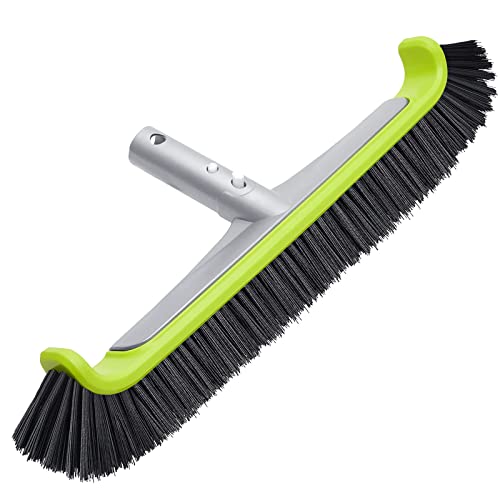
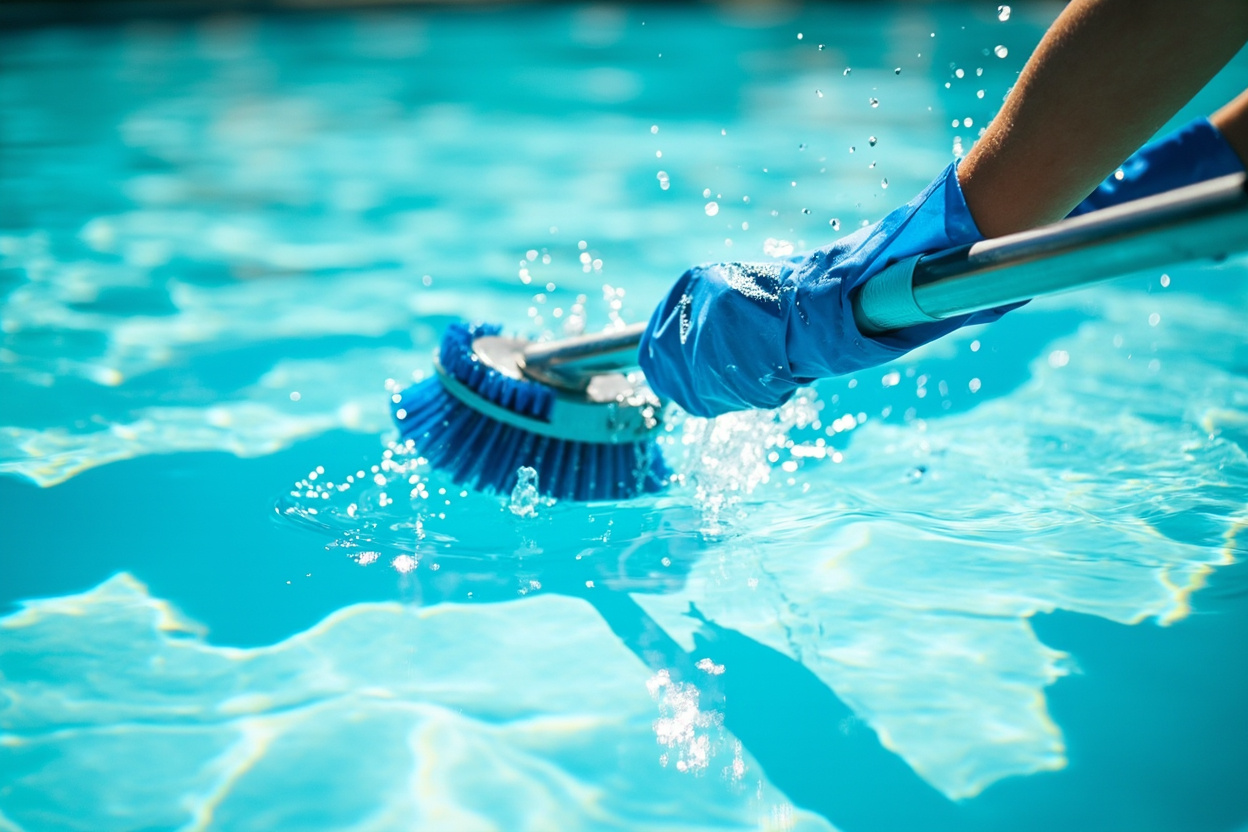
Skim the surface first, then brush the walls and floor — especially near returns, steps, and corners where algae gets its first foothold. Brushing is the step most owners skip, and it’s the one that matters most for prevention. Algae starts as a microscopic film you can’t see; by the time it’s visible green, it’s already anchored. Use a Sepetrel 17.5-inch pool brush — nylon for vinyl and fiberglass, stainless steel for plaster and gunite. After brushing, vacuum or run the robot to pull loosened debris through the filter.
Step 4: Check the filter
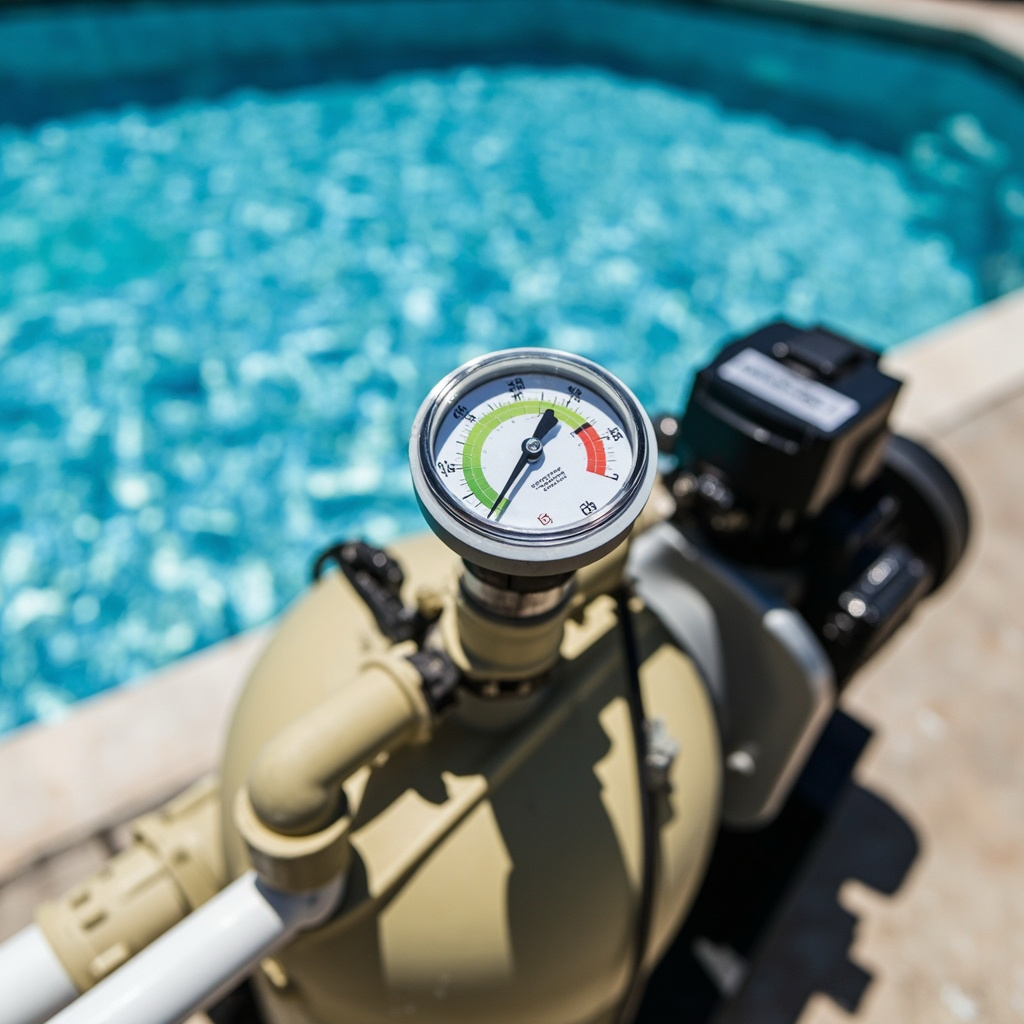
Look at the pressure gauge and compare it to your clean baseline. If pressure is 8–10 psi above baseline, it’s time to backwash (sand or DE filter) or clean the cartridge. Empty the pump basket and skimmer basket while you’re at it — a clogged basket starves the pump and reduces circulation, which means your chemicals don’t distribute evenly. A skimmer net with a telescopic pole makes basket cleanup and surface skimming faster.
Step 5: Top off water and inspect equipment
Check the water level — mid-skimmer is the target. If it’s low, add water with a hose and let it circulate before retesting chemistry. Inspect the pump, heater, and salt cell (if you have one) for leaks, buildup, or unusual sounds. A whining pump or a salt cell with visible scale are early warning signs that save you a service call if you catch them now.
Decision tree: which weekly routine fits your pool?
Not every pool runs the same weekly routine. Pick the branch that matches your setup — the rest of this guide covers the standard chlorine pool by default.
- If your pool is inground chlorine (standard): Run the full 5-step routine weekly. Trichlor tabs in the floater, brush plaster or gunite walls with a steel brush, and check CYA monthly to keep it from climbing past 50 ppm from the tabs.
- If your pool is inground saltwater: Skip the trichlor tabs — your cell makes chlorine. Inspect the cell weekly for scale, check salt ppm monthly (target per your cell manufacturer’s manual, commonly 2700–3400 ppm), and hold CYA at 60–80 ppm to protect the chlorine the cell generates. See the first-year pool owner guide for the full salt-vs-chlorine breakdown.
- If your pool is above-ground: Smaller volume means chemistry shifts faster. Test twice a week if the pool gets heavy use. Dose based on actual gallonage, not a guess. A skimmer net with pole is often your primary cleaning tool since many above-ground setups don’t have built-in vacuums.
- If your pool had a high-bather-load week: Test FC and pH the next morning. Shock only if CC reads above 0.5 ppm — see the pool shock guide for type selection. Brush extra that week; sweat and sunscreen feed algae growth fast.
- If your pool is a small or plunge pool: Small water volume heats up fast, so chlorine burns off quicker. Test every 3–4 days in summer. You’ll use less chemical per dose, but overshooting is easy — run the chemical dose calculator every time.
Monthly checks (beyond the weekly routine)
CYA and calcium hardness
Test CYA and calcium hardness (CH) once a month. As common industry targets, CYA should sit at 30–50 ppm for chlorine pools and 60–80 ppm for saltwater pools [source: Trouble Free Pool recommended levels]. Too high and chlorine becomes ineffective — you’ll need a much higher FC to get the same sanitizing power. Too low and UV burns through your chlorine before noon. CH varies by surface: 200–400 ppm for plaster, 150–250 ppm for vinyl and fiberglass [source: APSP/ANSI water balance standards].
Salt cell inspection (saltwater pools)
Pull the cell and look for white scale buildup on the plates. If you see scale, follow your cell manufacturer’s acid-wash instructions — commonly a 1:4 muriatic-acid-to-water soak for 10–15 minutes, but always confirm the dilution and contact time in your manual. Power off and remove the cell before cleaning. Check salt ppm while you’re at it. If chlorine output drops and salt is in range, the cell may need cleaning or replacement.
Deep clean tasks
Once a month, clean the tile line with a dedicated tile cleaner, check and lubricate O-rings on the pump lid and multiport valve, and inspect the pump lid gasket for cracks. These are the small maintenance items that prevent the expensive phone calls.
Seasonal peaks: how the routine changes
Summer — weekly is non-negotiable
Hot water (above 85°F) plus sun plus bathers means maximum chlorine demand. Test twice a week during heat waves. CYA protects chlorine from UV, so keeping it in range is your best defense against midday burn-off. If you’re running through tabs faster than expected, check CYA — it may be too low. The first-year pool owner guide has the full seasonal roadmap if you’re new to this.
Opening and closing season
Opening and closing are separate events — not part of the weekly routine. Opening requires a full chemistry reset after months of stagnant water. Closing requires balancing before you cover and adding winter chemicals. Both have their own sequences. Use the pool opening and closing checklist for those procedures.
As water cools below 60°F in fall, chlorine demand drops significantly. You can stretch to biweekly. Once you winterize, weekly care stops entirely until spring.
What you’ll need
Three buckets cover the basics: testing, chemistry, and physical cleaning. You don’t need everything on day one — start with test strips and a brush, then add as you learn what your pool actually needs.
Testing: AquaChek 7-Way Test Strips cover FC, pH, TA, CYA, and hardness on a single strip. Skip individual test kits unless you need lab-level precision — most homeowners don’t.
Chemistry: Clorox XTRABLUE 3-inch tabs for steady chlorine, pH Up and pH Down for adjustment. You may not need both — check your baseline first.
Physical cleaning: A Sepetrel pool brush and a skimmer net with telescopic pole handle 90% of weekly physical maintenance.
What to buy only if needed
- Algaecide: If algae keeps coming back despite correct chlorine levels, add a weekly preventative dose of Clorox Algaecide + Clarifier. But fix chlorine and circulation first — algaecide is backup, not primary defense. See the green pool guide if algae is already established.
- Shock: Use HTH Shock Advanced when CC reads above 0.5 ppm or after heavy bather load. Not every week — only when the numbers say so. See the pool shock guide for type selection.
- pH adjusters: If your pH holds steady week after week, you don’t need them. But summer heat and acid additions can push pH in either direction. Keep small tubs on hand — they’re inexpensive and they expire.
- Baking soda for TA: Plain sodium bicarbonate from the grocery store works the same as pool-labeled alkalinity increaser, often at half the cost. See the total alkalinity guide for dosing.
Safety notes (read this)
- Never mix different chlorine products dry or in a bucket — cal-hypo and trichlor in contact can cause a fire or toxic gas release.
- Never pour acid or shock through a skimmer that feeds an automatic chlorinator. The concentrated chemical hits the chlorinator and creates a dangerous reaction.
- Add chemical to water, not water to chemical, when pre-dissolving. Splashing acid the wrong direction sends fumes in your face.
- Wear gloves and eye protection when handling muriatic acid. Don’t breathe the fumes — pour slowly and keep your face back.
- Store all chemicals locked away from kids and pets, in a dry location. Moisture inside a chlorine bucket causes gas buildup and pressure explosions.
- Concrete dose reference (liquid chlorine, 10% sodium hypochlorite): About 1 oz per 10,000 gal raises FC roughly 1 ppm. Always run the chemical dose calculator for your exact pool volume and current reading — never eyeball.
- Swim re-entry after chemicals: Don’t swim until FC is back to your CYA-based target (1–3 ppm at CYA 30) and pH is 7.2–7.8. After a shock dose, wait until FC drops below 5 ppm before anyone gets in [CDC: healthy swimming / pool chemical safety].
Common mistakes in weekly pool care
1. Skipping the brush
Algae starts as a microscopic film on walls and steps. By the time you see green, it’s anchored and needs shock to remove. Brush weekly even if the water looks fine — a Sepetrel pool brush takes 5 minutes and greatly reduces the chance of algae anchoring.
2. Adjusting pH before alkalinity
pH and TA are linked. If you chase pH without fixing TA first, pH bounces right back within hours. Always fix TA first — it’s the anchor that keeps pH stable. See the total alkalinity guide for why this order matters.
3. Adding chlorine without checking CYA
Without knowing your CYA level, you’re guessing at how much chlorine you need. The Trouble Free Pool CYA/FC chart recommends a minimum FC of about 7.5% of your CYA reading — so at CYA 30 you’d target 1–3 ppm FC, but at CYA 100 you’d need 7–8 ppm minimum [source: Trouble Free Pool, chlorination/CYA chart]. Use the chemical dose calculator and test CYA monthly.
4. Ignoring filter pressure
A dirty filter reduces circulation, which means chemicals don’t distribute, debris settles, and algae gets a foothold. Check the gauge weekly and backwash or clean when it reads 8–10 psi above your baseline.
5. Dumping chemicals all at once
Adding chlorine, acid, and algaecide simultaneously can cause chemical reactions or cancel each other out. Add in order — TA, then pH, then chlorine — wait 30 minutes between additions, and run the pump to circulate between steps.
When to call a pro
Keep DIY if you can test, brush, adjust chemistry, run the filter, and the numbers are moving the right way. That covers most weekly maintenance situations.
Call a pro if:
- The pump won’t prime or you suspect electrical issues — water and electricity don’t mix with guesswork.
- Persistent algae after following the weekly routine correctly for 2+ weeks — see the green pool guide first, then call if the recovery stalls.
- You see structural cracks or unexplained water loss that suggests a leak.
- You’re not comfortable handling muriatic acid or cal-hypo shock — that’s a valid reason to outsource.
Related
- First-Year Pool Owner Guide — the big-picture roadmap for new owners
- Cloudy Pool — what happens when weekly care slips
- Green Pool — algae recovery (weekly care prevents this)
Key takeaways
- Weekly pool care = test, adjust chemistry (TA then pH then chlorine), brush and vacuum, check filter, top off water.
- Always fix TA before pH — it’s the anchor that keeps pH stable week to week.
- Brush weekly even when the water looks clear — algae starts invisible and you can’t kill what you haven’t loosened.
- Know your CYA level before adjusting chlorine — it sets your minimum FC target.
- Check filter pressure against your clean baseline every week; backwash when 8–10 psi above.
- Summer heat means test twice a week; shoulder season can stretch to biweekly.
- 20–30 minutes weekly prevents the 3-hour algae rescue nobody wants to deal with.