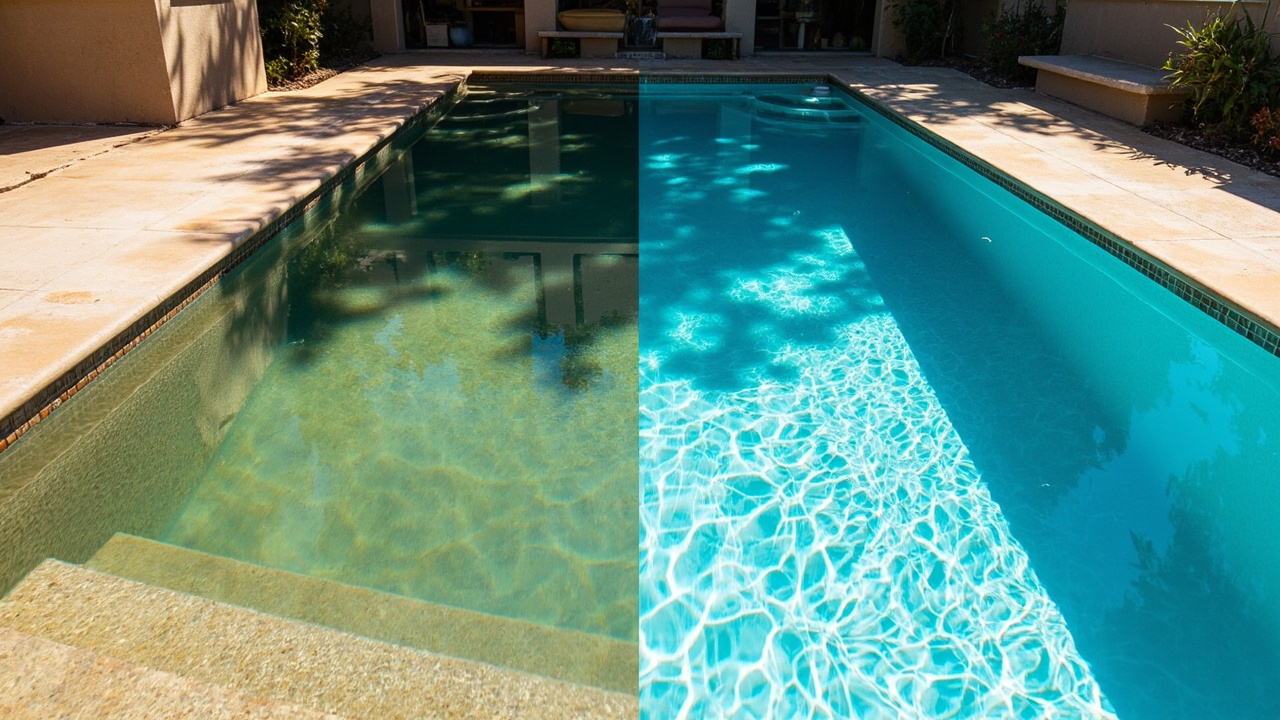
If the water is murky or tipping green, you do not need another tablet — you need a shock. Done wrong, you waste product and the water stays a mess. Done right, it is a straight sequence: test, dose, run the pump, retest.
Pool shock is one of three big-ticket pool tasks — opening, shocking, and balancing — and it sits between testing and the rest of your chemistry. This guide covers the four shock types, the dose math, the safe sequence, the constraints that flip your decision, and what to skip if your pool does not actually need it.
Quick answer
Pool shock is a one-time high dose of chlorine that breaks apart combined chloramines and organic buildup — what daily chlorine cannot reach. Test FC, pH, and CYA first, dose at dusk, run the pump overnight, retest FC before anyone swims. Use cal-hypo for routine oxidation, dichlor only when CYA is low, and MPS (non-chlorine) when you want minimal chemical swing.
What pool shock actually does (and does not)
What shock raises
Shock raises free chlorine (FC) high enough to reach two thresholds: breakpoint chlorination — the dose that breaks apart combined chloramines, measured by your CC reading — and, in algae cases, sustained high-FC levels that actually kill the algae cells. In a clean pool, a single dose bringing FC to 5–10 ppm overnight is enough to oxidize a day of bather waste and clear light haze.
What shock is not
Shock is not a daily sanitizer — your three-inch trichlor tablet does that, plus your routine water testing habit. It is not a substitute for testing. Shock with high CYA locks your chlorine and does nothing. It is not a same-day swimmer — wait until FC drops back to 1–3 ppm before anyone gets in.
The four shock types are not interchangeable. Cal-hypo adds calcium. Dichlor adds CYA. MPS adds neither but does not sanitize. Liquid chlorine adds nothing but is bulky and degrades fast in storage. Pick by your numbers, not by brand familiarity.
When to shock — the four trigger events
Routine oxidation
Every 1–2 weeks in summer, or after a heavy bather load (party, kids, dog in the pool). Routine doses aim for 1–2 ppm FC raise — small enough to clear the same day and not lock your CYA in a death spiral.
Visible contamination
Water turns dull or smells strongly of chlorine. A CC reading above 0.5 ppm on your test kit means your daily chlorine is not keeping up with the bather load or the rain — shock is the right next move, not another tablet.
Algae prevention or recovery
First sign of color — green tint, yellow on walls, black spots. Light algae can clear with a single heavy dose. Heavy algae needs sustained FC at 10–15 ppm for days, a SLAM-style effort, not a one-shot pour. If water is full green, walk through the green-to-clear pool guide first and only then escalate to heavy shock.
Open and close
Spring opening and winter closeout both call for shock. Treating the pool before balancing the rest of your chemistry clears CC and organics out of the way so your pH and TA work is not wasted. The open and close pool checklist ties this into the season calendar.
How shock fights your other numbers
Shock and CYA
Cyanuric acid bonds to free chlorine and protects it from UV — but too much CYA locks chlorine so it can sanitize slowly or not at all. A pool with CYA at 100 ppm has roughly one-third the effective FC of a pool with CYA at 30 ppm. Dichlor adds CYA every dose (about 10 ppm per 1 lb per 10k gal), so a season of dichlor-only shocking can push CYA past 100 ppm without explaining why “the shock did not work.”
Shock and pH
Cal-hypo raises pH slightly. Dichlor is acidic and lowers pH. Liquid chlorine raises pH more than cal-hypo per dose. If pH drifts up post-shock, aerate by running the spillover or fountain, then retest in 30 minutes. Do not combine a shock dose with a muriatic-acid adjustment in the same day — dose shock first, wait 8 hours, then acid if the numbers still justify it.
Skip / Do not use if
Skip cal-hypo if your CH is already above 600 ppm and rising — switch to liquid chlorine. Skip dichlor if your CYA is already above 50 ppm — it will push CYA higher and lock your FC. Skip non-chlorine (MPS) if water is green or visibly contaminated — it oxidizes but does not kill algae.
If you need to shock: a measured approach
Decide if shock is the right move
Test FC, CC, pH, and CYA first. If CC is below 0.5 and water is clear, shock is wasted — your daily chlorine is keeping up. If CC is above 0.5 OR visible algae is present OR you just had a heavy bather/rain event, shock is justified. The decision tree is: test → which number is wrong → which type → how much → when to swim.
Above-ground vs inground vs saltwater
Above-ground pools (vinyl liners) hold less water, so doses run lower. Cal-hypo works but watch your CH. Inground pools (plaster, gunite, fiberglass) can handle larger doses; cal-hypo is the workhorse unless CH is already high. Saltwater pools still need manual shock — use cal-hypo or liquid chlorine, since the salt cell handles routine and you handle spikes. For the salt-side math, the salt pool dose calculator covers steady-state, not shock.
What you’ll need
(Listed here as products first appear — IA §9 embed mode 1.)
- Cal-hypo shock, 65–73% available chlorine (1 lb per 10,000 gal raises FC ~10 ppm)
- A 7-way test strip that reads CYA (you cannot dose correctly without it)
- A clean 5-gallon plastic bucket for pre-dissolving
- Gloves and eye protection
- A working pump and filter (8+ hours runtime post-shock)
- Pool volume in gallons (check your pump specs or measure)
Our pick for most chlorine pools is HTH 52037R Pool Shock Advanced at 1 lb per 10k gal. Skip it for saltwater pools or vinyl liners with a history of calcium scale — switch to liquid chlorine instead.
For mid-size pools (15–25k gal), In The Swim 68% cal-hypo is the reliable mid-tier option. Skip it on fiberglass with rising calcium hardness or on saltwater pools with high-CH fill water.
If you need multi-bag cost savings for a heavy algae recovery, Doheny’s Super Pool Shock comes in a 24-pack and runs breakpoint chlorination doses cheaply. Skip it for routine 1–2 ppm raises — overkill and CH-heavy.
For maximum strength per pound, Rx Clear Mega Shock at 73% means a smaller bag weight per ppm raise, which helps when the filter cover is the only place to store it. Skip it for routine oxidation — overkill and CH-heavy.
For buying criteria across all four shock types rather than chemistry instructions, browse Pool Essentials where each type gets its own decision guide.
Step-by-step: shocking a pool the right way
1. Test first
Log FC, pH, TA, and CYA. If pH is below 7.2 or above 7.8, fix that first — extreme pH makes shock less effective. If CYA is already at or above 100 ppm, switch to liquid chlorine instead of cal-hypo or dichlor. A fresh bottle of 7-way test strips covers the four numbers you need at a price that fits a routine habit. Skip liquid strips if you already own a Taylor K-2006 — the liquid kit reads FC more precisely in the FC range that matters for shock.
2. Calculate the dose
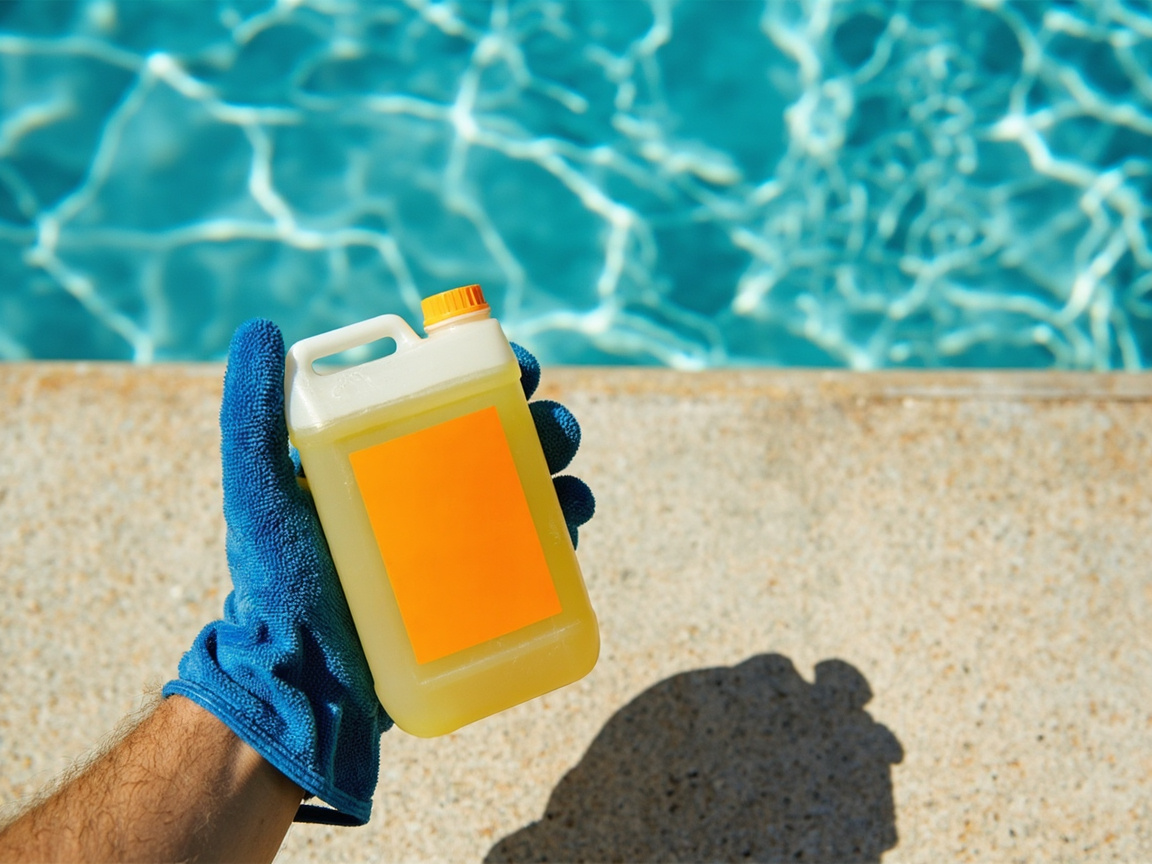
A practical rule: 1 lb of cal-hypo per 10,000 gallons raises FC roughly 10 ppm at 65% available chlorine. Use the label percentage to refine — 73% cal-hypo delivers more chlorine per pound than 65%. A 20,000-gallon pool targeting 10 ppm FC needs 2 lb at 65% or about 1.75 lb at 73%. For the exact math on your volume and target ppm, the chemical dose calculator does the arithmetic — confirm the inputs first with fresh test data.
3. Add shock safely
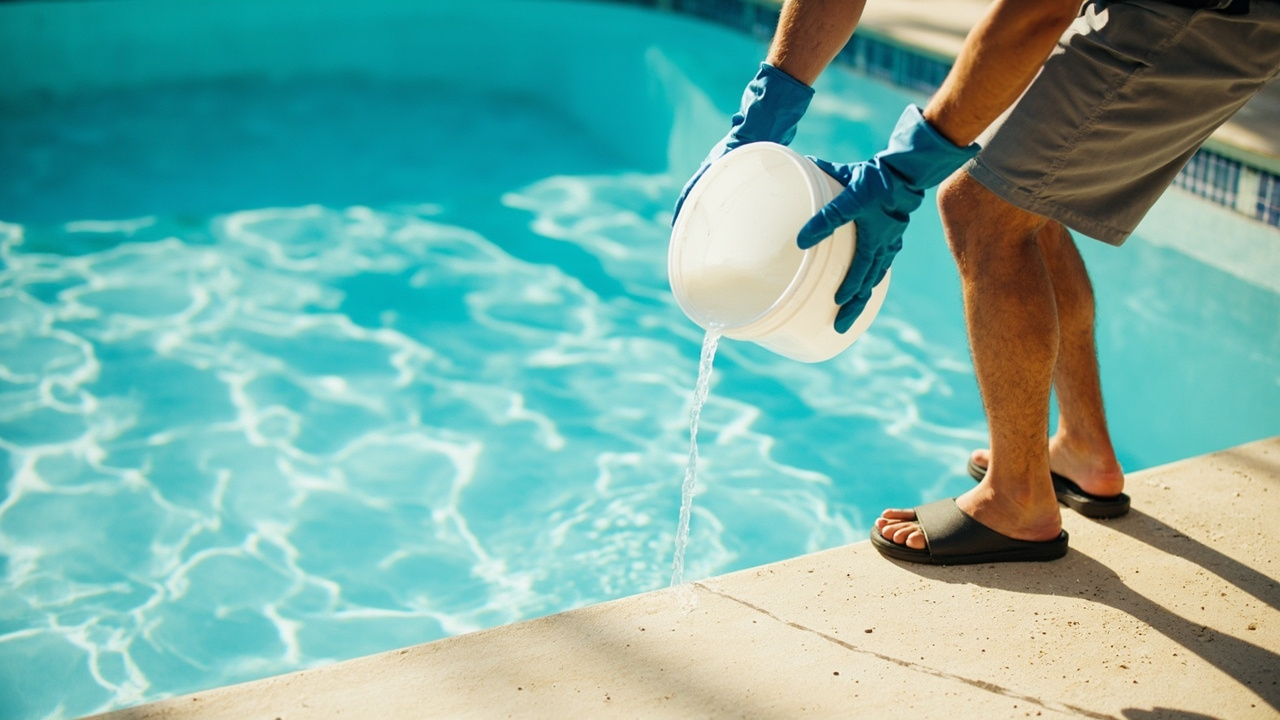
Pre-dissolve in a clean plastic bucket. Add chemical to water — never water to chemical. Walk the bucket to the deep end and pour slowly along the edge. Stay out of the skimmer if your pad has an automatic chlorinator or salt cell downstream — a concentrated shock slug into those can cause toxic gas or damage cell plates.
4. Run the pump
Run the filter 8+ hours, ideally overnight. Brush any settled granules into suspension so the FC gets distributed, not trapped on the floor. If filter pressure rises 8–10 psi above the clean baseline, backwash or clean the cartridge. Skipping this step is the most common reason shock “did not work” — the chlorine sits in dead zones.
5. Retest before swimming
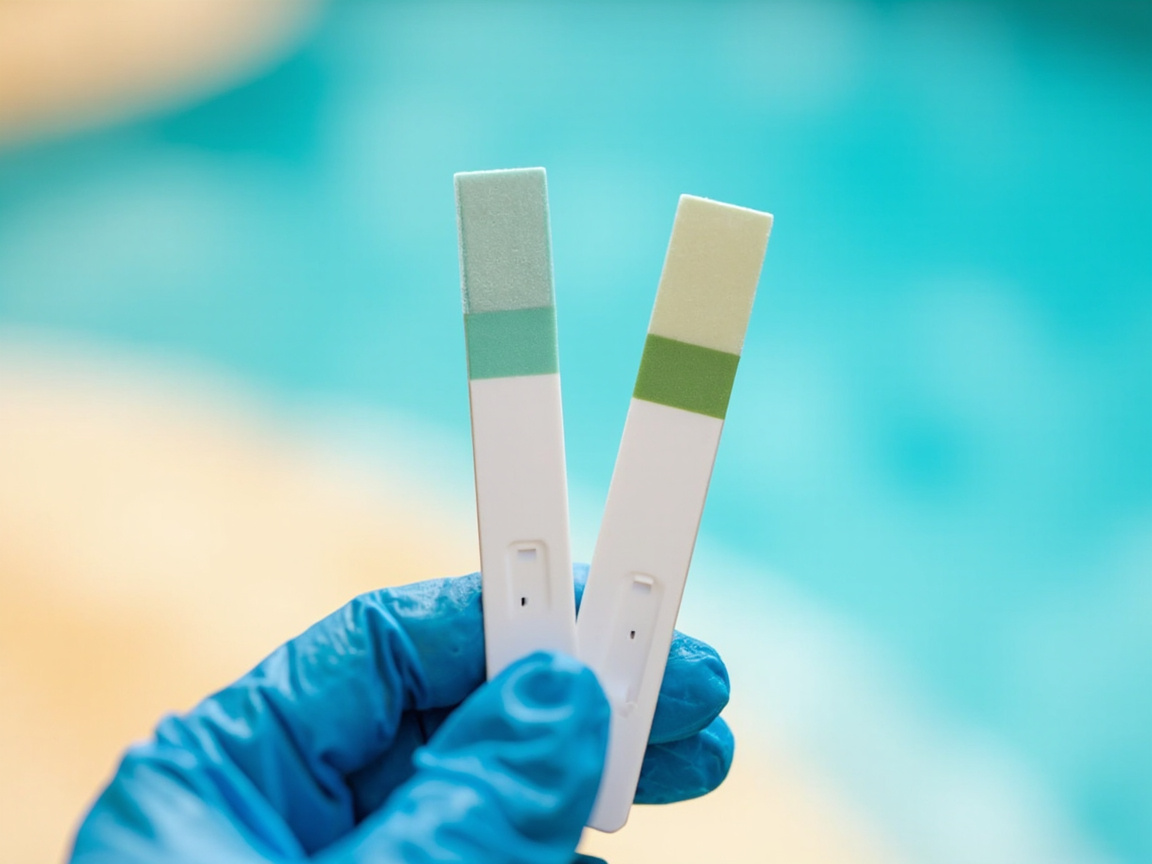
After 8–24 hours, retest FC. Wait until FC is back at 1–3 ppm before anyone swims. A branded bottle of test strips gives clearer color blocks than budget strips for the post-shock retest window. Skip the immediate swim if FC is still above 5 ppm — burning eyes is the cheapest sign you got the timing wrong. If CC is still above 0.5 or visible algae remains, repeat after 24 hours. Do not stack doses without FC data each time.
Common mistakes
Skipping the test
Shocking without knowing CYA is the number one reason “the shock did not work.” Test first, every time. Cheap strips that skip CYA — a 7-way strip that reads CYA alongside FC is the only way you can dose with confidence. If strips still do not give you confidence on FC, swap to a Taylor K-2006 liquid kit for the algae-decision range.
Mixing chemicals dry
Never combine cal-hypo with dichlor, trichlor, algaecide, or acid in the same bucket — dangerous reactions are possible. Pre-dissolve shock in clean water only and add it to the pool, not to other products.
Pouring near the skimmer
High-concentration shock through a skimmer that feeds an automatic chlorinator or salt cell can produce toxic gas or damage cell plates. Walk the bucket to the deep end. If your pad layout only has the skimmer, broadcast across the surface with the pump off, wait 10 minutes for dilution, then run the pump.
Re-shocking without checking CYA
If CYA is the actual problem — locked chlorine — more shock does not help. Drain and refill part of the pool, or switch to liquid chlorine which adds no CYA. The green-to-clear wizard walks through the CYA-vs-algae call when two correct shocks have not cleared it.
Swimming too soon
FC at 10 ppm burns eyes and skin within minutes. Retest before anyone gets in. If FC is still above 5 ppm after 8 hours, wait — adding more shock will not speed the recovery, only the swim-safety gap.
When to call a pro
Call a pro if FC keeps slipping despite two correct doses (likely nitrogen source, phosphate overload, or a hidden leak). Call a pro if you suspect structural leak, pump electrical issues, or persistent black algae after a multi-day high-FC effort. Call a pro if you are not comfortable handling muriatic acid alongside chlorine products — a slip in that order can release a sharp gas cloud.
Safety notes (read this)
- Never mix different chlorine products dry or in a bucket.
- Never pour shock through a skimmer that feeds an automatic chlorinator or salt cell.
- Add chemical to water, not water to chemical, when pre-dissolving.
- Gloves and eye protection; do not breathe dust from containers.
- Store locked away from kids and pets, separate from acid.
- Liquid chlorine degrades fast — rotate stock every 4–6 weeks in summer heat.
What to buy only if needed
Only if CYA is below 50 ppm
Dichlor becomes a viable shock — it raises FC and adds CYA in one move. Use In The Swim Sodium Dichlor for slow-release outdoor coverage. Skip it the moment CYA crosses 50 ppm — every dose makes the next shock harder.
Only if you want to swim within an hour
MPS (non-chlorine) shock is safe to swim about 15 minutes after a dose. In The Swim Chlorine-Free Shock fits indoor pools and same-day parties. Skip it the moment water is green — MPS oxidizes but does not kill algae.
Only if your test strips do not read CYA
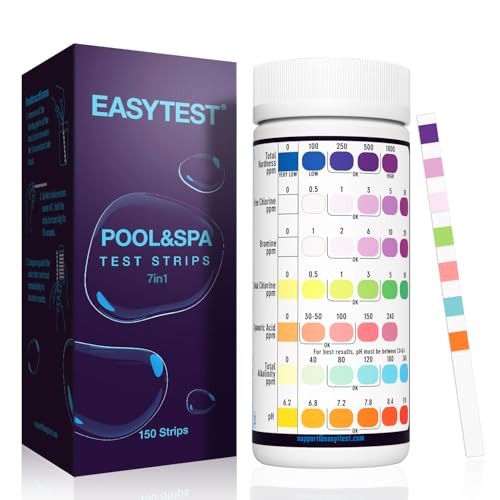
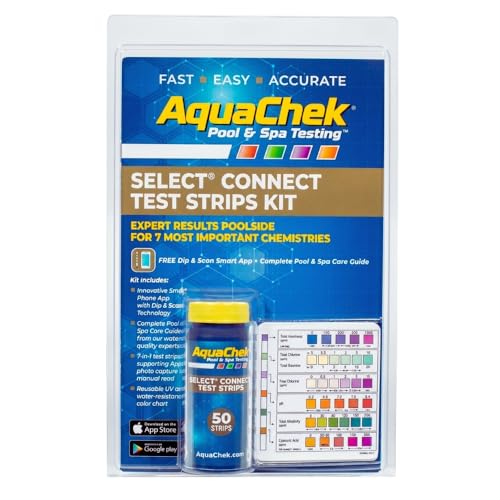
Upgrade to a 7-way strip that does — EASYTEST 7-Way is the value pick, and AquaChek Select Connect is the trusted brand pick. Skip the upgrade if you already own a Taylor K-2006 — liquid reagent is more accurate in the FC range that matters most for shock.
Only if your pool is plaster with high CH
Switch to liquid chlorine to stop adding calcium. Cal-hypo raises CH about 2 ppm per 1 lb per 10k gal — over a season of heavy shocking, that compounds. Liquid chlorine adds nothing but chlorine and degrades fast in storage. Skip the switch if your CH is below 400 ppm and stable — cal-hypo is still the workhorse.
Related
- Green-to-clear pool guide — full recovery path when shock alone is not enough.
- Pool water testing — the gating step before every dose.
- Chemical dose calculator — math for your specific pool volume + target ppm.
- Salt pool dose calculator — saltwater steady-state context where manual shock still matters.
Key takeaways
- Test first — FC, CYA, pH — or you are guessing. CYA is the silent killer.
- Cal-hypo for routine, dichlor only when CYA is low, MPS when you want minimal chemical swing.
- Never pour through a skimmer that feeds an automatic chlorinator or salt cell.
- Dose at dusk, pre-dissolve, walk the bucket to the deep end.
- Run the pump 8+ hours, brush settled granules, retest FC.
- Wait until FC drops back to 1–3 ppm before swimming — usually 8–24 hours.
- If two correct shocks do not clear the algae, the problem is CYA, not the chlorine type — escalate to liquid chlorine or call a pro.