If pH looks fine on Monday and runs off the scale by Friday, total alkalinity may be the number causing the trouble. Guessing wastes acid, increaser, and a second afternoon. Once you separate TA from pH, the job gets simpler: confirm the reading, pick one direction, dose in small passes, circulate, and retest.
Quick answer
Aim for 80–120 ppm total alkalinity in most residential pools, unless your equipment maker or local guidance gives another target. Raise low TA with sodium bicarbonate. Lower high TA with measured acid doses, using aeration between doses to bring pH back up without restoring TA. Test with a liquid titration kit before a large correction, keep the pump running during treatment, and retest before adjusting pH or swimming.
What total alkalinity actually does in your pool
Total alkalinity is the water’s resistance to a sudden pH change. It comes mainly from bicarbonate and is reported in parts per million as calcium carbonate. Think of TA as a shock absorber: it doesn’t set the exact pH, but it controls how easily that reading moves.
TA buffers pH swings
With enough alkalinity, a little rain, makeup water, or sanitizer won’t throw pH across the chart. With too little, those events can send pH down or up fast. Low-pH water can attack plaster and metal; high-pH water encourages scale and weakens chlorine performance.
High TA creates the opposite headache. Water resists an acid correction, then pH creeps upward as carbon dioxide leaves the water. You keep adding acid without addressing the buffer behind the rise.
TA vs pH — they’re different
pH tells you how acidic or basic the water is right now. TA tells you how hard it is to change that pH. A pool can have pH 7.5 and TA 200 ppm; the pH looks acceptable, but it may soon climb. It can also have pH 7.5 and TA 40 ppm; one chemical addition may knock that pH out of range.
TA and pool surfaces
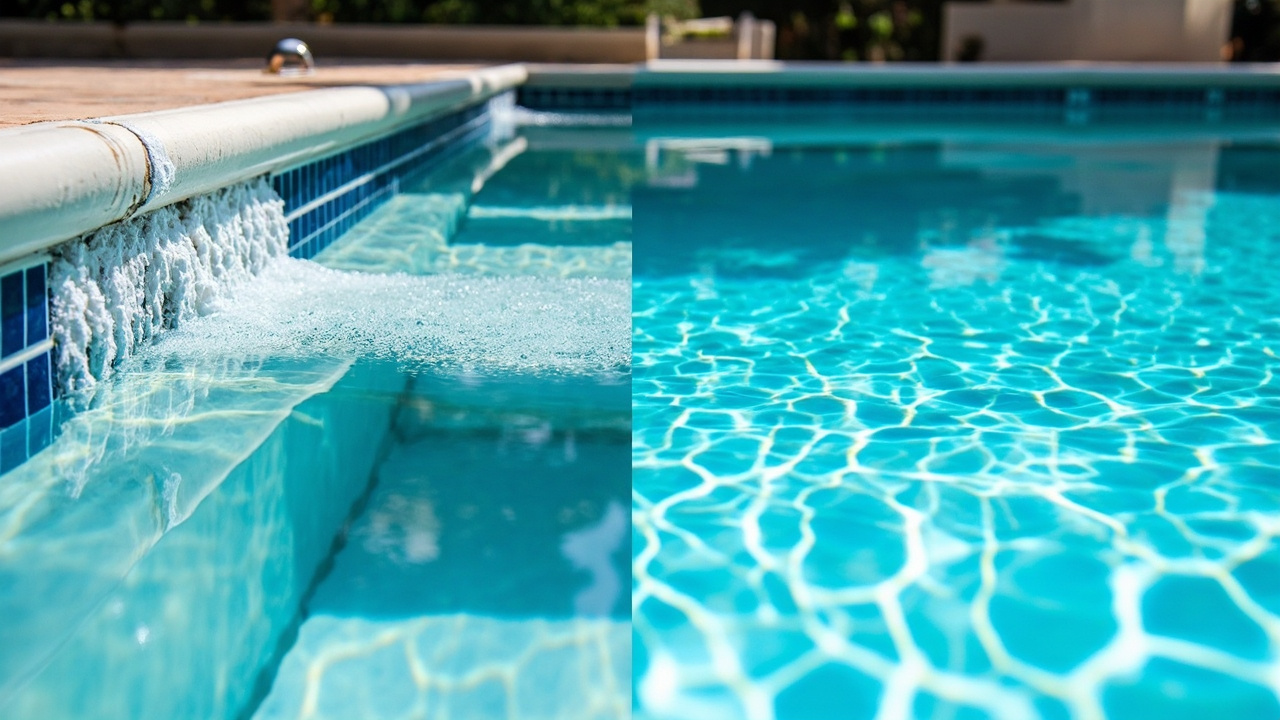
TA isn’t a surface reading by itself. Its damage usually arrives through the pH and saturation balance it allows. Low TA paired with low pH can etch plaster, dull grout, and corrode heater parts. High TA paired with high pH and calcium hardness can leave a rough scale band on tile or inside a heater. Vinyl and fiberglass pools avoid plaster etching, but they still need stable pH for equipment and swimmer comfort.
What this is not: TA is its own number
- TA isn’t pH. Don’t add alkalinity increaser just because pH is low.
- TA isn’t calcium hardness. Hardness is a separate part of scale and corrosion control.
- TA isn’t cyanuric acid. CYA protects chlorine from sunlight and can affect test interpretation, but it isn’t a TA correction product.
- TA isn’t sanitizer. A perfect TA reading won’t clear algae or replace free chlorine. If water is already green, start with the green-pool recovery steps.
Ideal pool TA range (and how it differs from pH)
A sensible starting target for a backyard chlorine or saltwater pool is 80–120 ppm. Treat 60 ppm as a warning floor, not a goal. Above roughly 150 ppm, repeated pH rise, cloudiness, and scale become more likely, especially when calcium hardness is also high.
| TA reading | What it usually means | Next move |
|---|---|---|
| Below 60 ppm | Weak buffer; pH can swing sharply | Confirm with liquid test, then raise TA |
| 60–79 ppm | Low edge; may work in some managed systems | Watch pH trend and follow equipment guidance |
| 80–120 ppm | Common residential target | Leave it alone |
| 121–150 ppm | High side but not always urgent | Track pH before buying acid |
| Above 150 ppm | Repeated pH rise and scale risk increase | Confirm, then lower in stages |
| Above 250 ppm | Large correction | Check fill water and consider partial replacement |
Don’t chase a single perfect number. Test error, fill water, surface type, calcium hardness, and sanitizer system all change the practical target. Saltwater cells often make pH rise faster because of aeration at the cell and returns; that doesn’t mean the cell is adding TA. It means a lower-end, stable TA target may reduce the pH climb. Check the cell maker’s instructions before changing the range.
How to test pool TA (test strips vs liquid kit vs titration)
Take the sample from elbow depth, away from a return, skimmer, or recent chemical addition. Rinse the vial with pool water. Test before treatment and again only after the product has circulated for the label’s stated time. For a wider testing schedule, see how to test pool water without chasing bad readings.
Test strips vs liquid kit vs titration
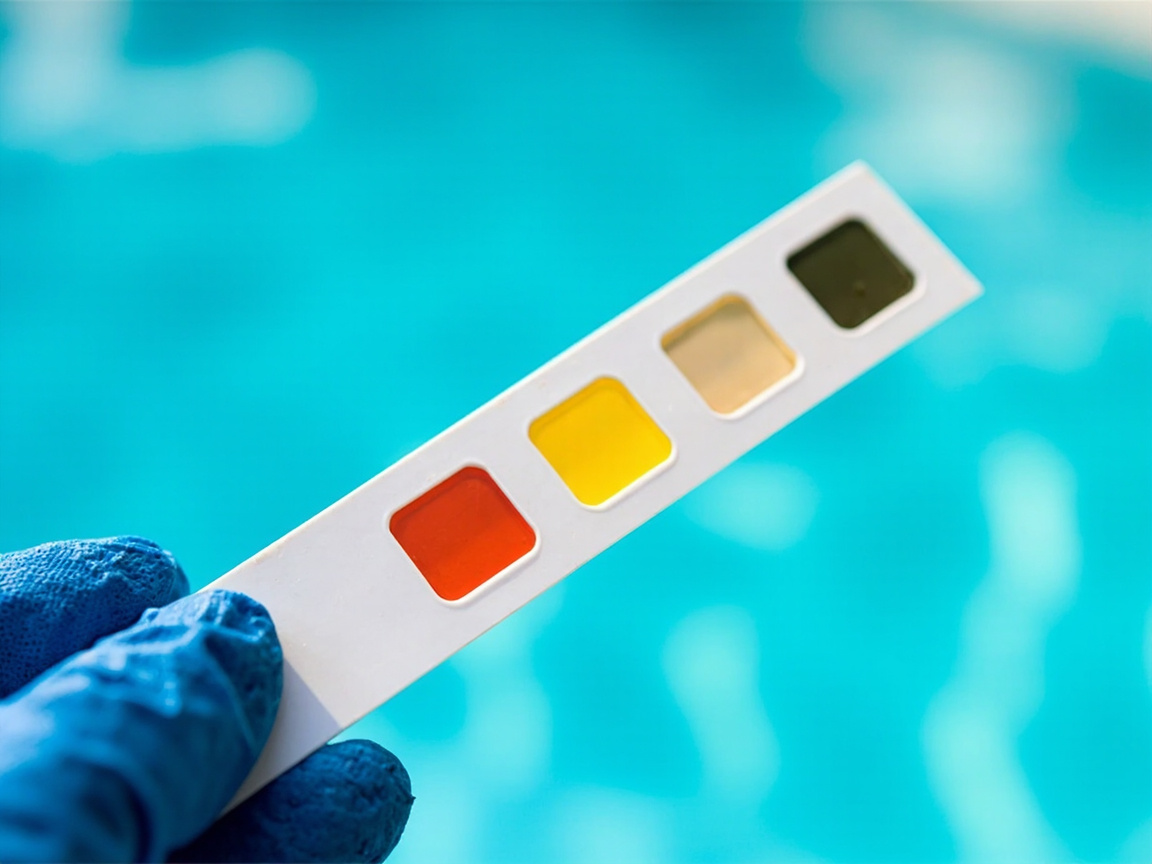
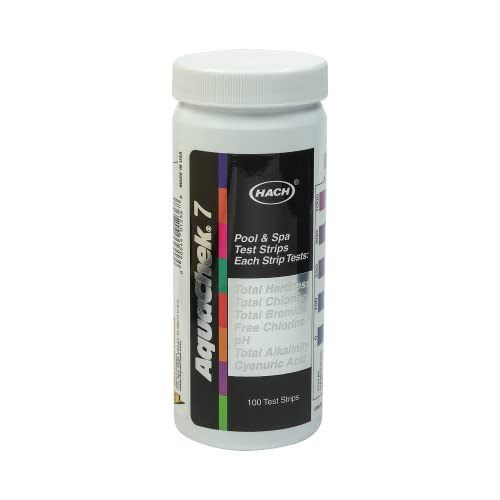
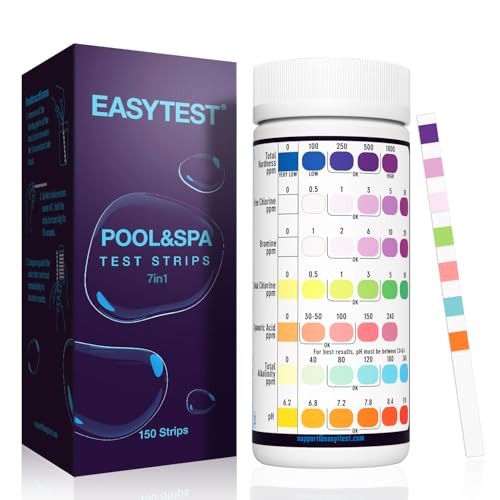
Strips are useful for a weekly trend. AquaChek 7-Way strips show TA beside pH, sanitizer, hardness, and CYA. EASYTEST 7-Way strips fill the same quick-check role at a different pack size. Keep either jar sealed, dry, and indoors. Don’t dose a big acid correction from one vague color block.
A drop-count titration gives a narrower result. Our pick for a correction decision is the Taylor K-1004 liquid test kit. Follow that kit’s fill line, reagent order, drop size, and endpoint color exactly. Many titrations use a factor of 10 ppm per drop, but the kit instructions—not a generic shortcut—set the factor.
Run the titration without guessing
- Rinse and fill. Use a fresh pool sample at the marked volume.
- Add the indicator. Cap and swirl as the kit directs. Don’t swap droppers between bottles.
- Count each titrant drop. Hold the bottle straight up and swirl after every drop.
- Stop at the stated endpoint. Count the drop that completes the lasting color change.
- Calculate and record. Apply the kit’s factor, write down TA and pH, then rinse the cell.
If a strip and titration disagree by enough to change your treatment, repeat the titration with fresh water. Don’t average a questionable strip into a reliable liquid result.
How to raise low pool TA
Raise TA only after a liquid test confirms it is low. Sodium bicarbonate is the usual active ingredient in a pool alkalinity increaser. It raises TA with a smaller pH effect than soda ash, which is meant primarily to raise pH.
What you’ll need for a low-TA correction
- A liquid TA and pH test
- Sodium bicarbonate or a pool-labeled alkalinity increaser
- The pool’s measured volume
- A clean plastic scoop or bucket, if the label calls for one
- Gloves, eye protection, and a running circulation system
Step-by-step: raise low TA
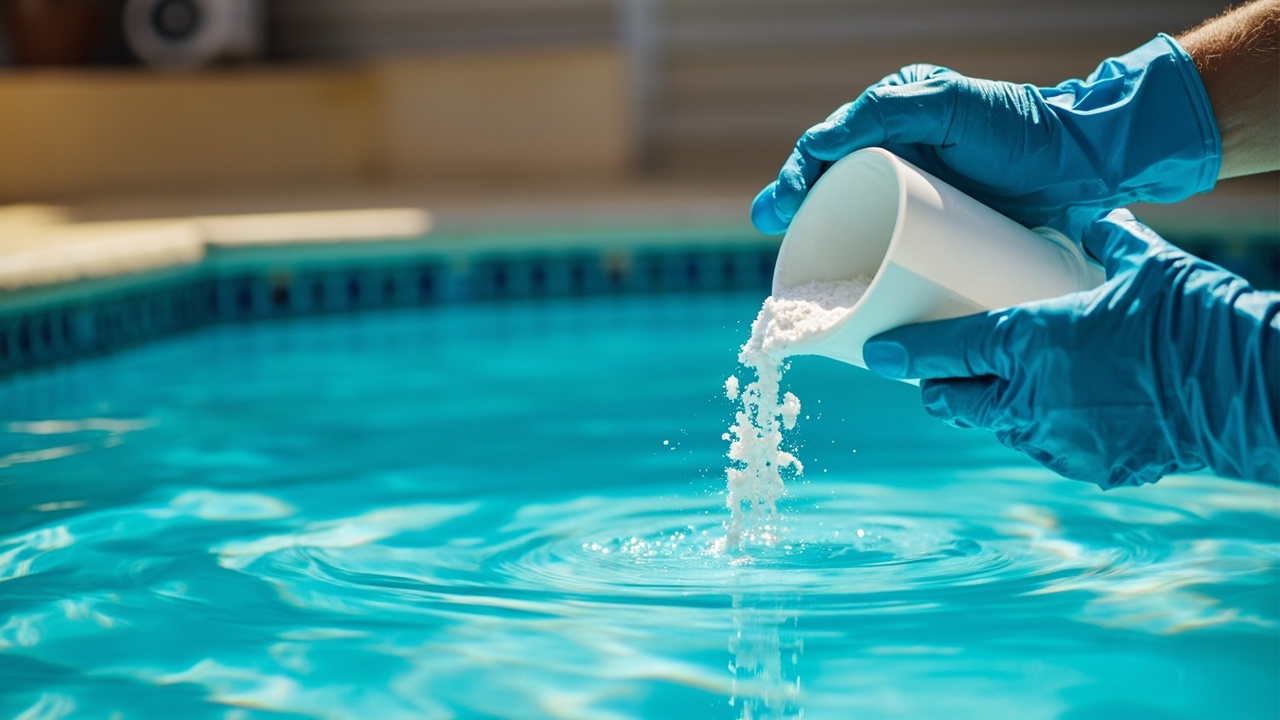
- Confirm the volume and reading. A common starting rule is about 1.4–1.5 lb of sodium bicarbonate to raise TA by 10 ppm in 10,000 gallons, but use the package label for the actual product.
- Calculate one conservative pass. The pool chemical dose calculator can help translate pool volume and the desired change. Round down rather than overshooting.
- Add as the label directs. Broadcast over the deep end or pre-dissolve only when the label allows it. Keep the pump running.
- Brush any settled powder. Don’t let granules sit on a liner or plaster step.
- Circulate and retest. Wait for the label’s circulation interval, often several hours, then test TA and pH again before adding more.
Our pick for a modest correction is Clorox Pool & Spa Alkalinity Increaser, 5 lb. For a larger pool or a deeper confirmed deficit, Pool Mate Premium Alkalinity Increaser, 10 lb avoids stacking several small containers. In The Swim Solvay Bicar Alkalinity Up, 50 lb is a bulk buy; skip it for a one-time backyard correction.
Don’t use any increaser if TA is already 80 ppm or higher and stable. Don’t use soda ash as an equal substitute when TA is the only low number; it can push pH higher than planned.
How to lower high pool TA (three methods)
Confirm both TA and pH before lowering anything. Acid lowers pH and TA together. Aeration then raises pH by driving carbon dioxide out, without raising TA back up. That paired cycle is why high-TA correction takes patience.
Decision tree: which TA move fits your reading
- TA below 60 ppm: add sodium bicarbonate to bring TA into the 80-120 range. Without enough TA, any pH adjustment bounces wildly. Aim for slow doses — typically 1.5 lb per 10,000 gallons raises TA ~30 ppm.
- TA 60-80 ppm: low-normal. If pH is stable and you have no history of swings, monitor. If pH drifts, add a small bicarbonate dose.
- TA 80-120 ppm: ideal for chlorine pools. Don’t treat a number with no symptom. Re-test in a week; if TA creeps up, plan aeration before the next rain.
- TA 120-150 ppm: still acceptable. If pH rises week-over-week, treat as a “leading indicator.” A small acid dose now beats chasing high pH later.
- TA 150-180 ppm: high. Small acid dose (muriatic or dry acid), circulate, then aerate aggressively. Do not chase pH without bringing TA down — they fight each other.
- TA above 180 ppm: stop. Aeration alone won’t help. Either (a) split a full muriatic acid dose across 3-4 passes with circulation and retesting between each, or (b) test fill water and consider partial drain-and-refill (only works if fill TA is much lower).
Aeration to lower TA: what it can and can’t do
Aeration alone does not lower TA. It raises pH without adding alkalinity. Use it after an acid dose: point return jets up, run a fountain, or use another clean aeration method until pH recovers. Then test both numbers. If TA remains high, repeat a smaller acid-and-aeration cycle.
Skip aggressive aeration if pH is already high and you haven’t added the measured acid dose. Don’t run a spa spillway or fountain blindly for days; pH can climb while TA barely changes.
Lower TA with muriatic acid
Muriatic acid is fast and inexpensive per treatment, but its fumes and splash risk make storage and handling harder. Use the concentration printed on the label and calculate from that concentration. If the label directs dilution, add acid to water in a clean plastic bucket outdoors—never water into concentrated acid. Pour into circulating water where the label directs, away from fittings and swimmers.
Start with a fraction of the calculated amount, circulate, and retest. Don’t pour acid through a skimmer, and don’t add it near chlorine. Skip muriatic acid if you don’t have ventilated storage, protective gear, or confidence handling it. Dry acid or a pool service is the better branch.
Use dry acid when storage is the deciding factor
Sodium bisulfate lowers pH and TA without liquid-acid fumes, but it is still corrosive. MAV AquaDoc pH Down, 5 lb fits a confirmed smaller correction. Leslie’s Dry Acid pH Down, 10 lb is the larger-container option.
Use the product label rather than a one-size dose copied from another brand; active strength and pool volume matter. Don’t breathe the dust, and don’t assume granular acid can share a scoop or shelf with chlorine.
Drain and replace when the water source helps
Partial replacement works only if the incoming water has a lower TA than the pool. Test tap or well water first. Also check local discharge rules, groundwater level, liner risk, and water restrictions. Never empty a fiberglass or vinyl pool casually; hydrostatic pressure can lift a shell and a liner can shift or shrink. When replacement is the right move, drain in smaller stages and retest after refilling.
TA fights with pH (and why you adjust TA first)
TA and pH corrections can turn into ping-pong when they’re done in the wrong order. A high-TA pool may return to high pH soon after acid. A low-TA pool may show a large pH change from a small dose. Read the pool pH hub before buying a second product for the same swing.
Adjust TA before pH
If TA is far outside your target, correct it in measured passes first. Then retest pH. Often the TA treatment has already changed pH enough that the next dose is smaller—or unnecessary.
If pH is also unstable, don’t treat the strip like a shopping list. Confirm both numbers with a Taylor K-1004 liquid kit, correct TA, circulate, and retest. Don’t add alkalinity increaser and acid on the same pass. Don’t shock the pool at the same time just because sanitizer also looks low; stage separate treatments according to their labels. Our pool-shock guide explains that separate job.
Borate buffer: a TA alternative
Borates can slow pH rise in some pools, especially systems that aerate heavily. They are not a substitute for carbonate alkalinity and won’t fix TA at 200 ppm. Think of them as an optional second buffer after TA and pH are already under control.
Use borates only after the main numbers are stable
Test the existing borate level, calculate the dose from the exact product, and account for the pool’s volume. A Duda Energy 10-lb boric acid package is a larger option. Eco Living Solutions 12-oz boric acid is a small package, not enough for many full-size pools.
Skip borates if you don’t want to test another parameter. Don’t add them as a quick answer to high TA, low TA, algae, or poor sanitation. Keep borate products locked away from children and pets, prevent ingestion of pool water, and follow local rules and the product label.
What you’ll need
Build a compact TA correction kit
Build the kit around the reading you have:
- For a trustworthy decision: a liquid TA titration kit. Strips are the weekly flag, not the final dose number.
- For confirmed low TA: a sodium-bicarbonate product such as Clorox Alkalinity Increaser.
- For confirmed high TA: one pool-labeled acid. MAV AquaDoc dry acid avoids liquid fumes but still needs careful handling.
- For the work: gloves, splash goggles, a clean plastic measure, and the pool’s volume.
- For the retest: a log with TA, pH, dose, circulation time, and fill-water additions.
The chemical dose tool can turn the reading into a starting amount. It can’t verify pool volume, product strength, or stale tests. Feed it good numbers, round down, and follow the label.
What to buy only if needed
Buying every balancer at once is how shelves fill with old chemicals. Match one purchase to one confirmed branch.
- Buy an alkalinity increaser only if TA is low. Choose a 5- or 10-pound size for an ordinary correction. A 50-pound sack belongs with a large pool or repeat use, not a single 10 ppm change.
- Buy acid only if TA is high and pH behavior supports the diagnosis. Choose muriatic acid only when you can store and handle it safely. Choose dry acid when fumes or liquid storage are the deal-breaker.
- Buy a liquid kit if the decision is expensive. A fresh Taylor K-1004 kit costs less than draining water after a bad dose.
- Buy boric acid only after TA and pH are stable. It is optional pH-drift control, not the first correction.
- Buy strips only for trend checks. They make sense when you already own a liquid test for confirmation.
For test gear, storage basics, and other pool-care categories, see the pool essentials hub. Skip bulk packages until you’ve used a smaller container and know the pattern will repeat.
Common pool TA mistakes
Cheap strips don’t read TA accurately enough for a big correction
A wide color block can hide a 20- or 40-ppm difference. EASYTEST 7-Way strips are useful for a trend, but don’t turn one strip into a large acid order. Confirm first.
Aerating without acid
A fountain looks active, so it feels like treatment. It isn’t removing alkalinity. Aeration raises pH; the preceding acid dose is what lowers TA. Use the pair in the right order.
Fixing pH before a wild TA reading
Repeated pH Up and pH Down doses can cancel each other while TA stays wrong. Confirm TA, correct it, circulate, then decide whether pH still needs help.
Making one giant correction
A large bicarb dose can overshoot TA. A large acid dose can drive pH low enough to etch plaster, attack metal, or make the pool unsafe to enter. Split the work, log each dose, and retest.
Ignoring fill water
If every top-up brings high-TA well water, the pool will drift back. Test the source once. That number shows whether partial replacement will help or make the problem worse.
Safety notes (read this)
- Keep swimmers and pets away during dosing and circulation. Reopen only when pH, sanitizer, and any label-specific waiting period are back in range.
- Never mix acid with chlorine, shock, soda ash, bicarbonate, or another pool product. Contact can release heat, splatter corrosive liquid, or produce dangerous gas.
- Never pour acid through a skimmer that feeds a chlorinator or salt cell.
- If a label calls for dilution, add acid to water—not water to acid—using a dedicated plastic container outdoors.
- Wear splash goggles and chemical-resistant gloves. Stay upwind of muriatic fumes and dry-acid dust.
- Store acid apart from chlorine in a cool, ventilated, locked area. Don’t reuse kitchen tools or food containers.
- For a spill, splash, or inhalation exposure, follow the label’s first-aid directions and contact the local poison center or emergency service.
When to call a pro
Keep the job DIY when the pump circulates normally, your TA and pH tests repeat, and each small dose moves the numbers as expected.
Call a pool professional when TA remains extreme after measured cycles, scale is spreading through a heater or salt cell, a large drain may be needed, or you aren’t comfortable handling acid. Stop for pump, electrical, structural, or groundwater problems. If green water isn’t improving, use the green-to-clear decision tool to separate chemistry from filtration trouble.
Related pool chemistry
Start with the full pool-water testing routine when two methods disagree. Use the pH guide for the reading TA buffers, and read how pool shock works before scheduling sanitizer near an alkalinity correction. New owners can place TA testing inside a first-year pool-care routine. If algae is the visible problem, follow the green-pool recovery path instead of treating TA as the whole cure. The green-to-clear tool helps sort the next step, while pool-care essentials covers what to buy after the test identifies a real gap.
Common questions
The six _faq answers cover range, high TA, vinegar, surface damage, adjustment order, and swimming. The methods stay above.
Key takeaways
- TA is the pH buffer, not the pH reading or sanitizer level.
- Start with an 80–120 ppm target unless your system guidance says otherwise.
- Raise confirmed low TA with sodium bicarbonate in small, labeled doses.
- Lower high TA with acid followed by aeration; aeration alone doesn’t lower TA.
- Confirm a large correction with a liquid titration instead of one strip.
- Correct TA first, then retest pH before buying another chemical.
- Never mix pool chemicals, and don’t make one giant correction.